
Try a Summer Colour Hunt
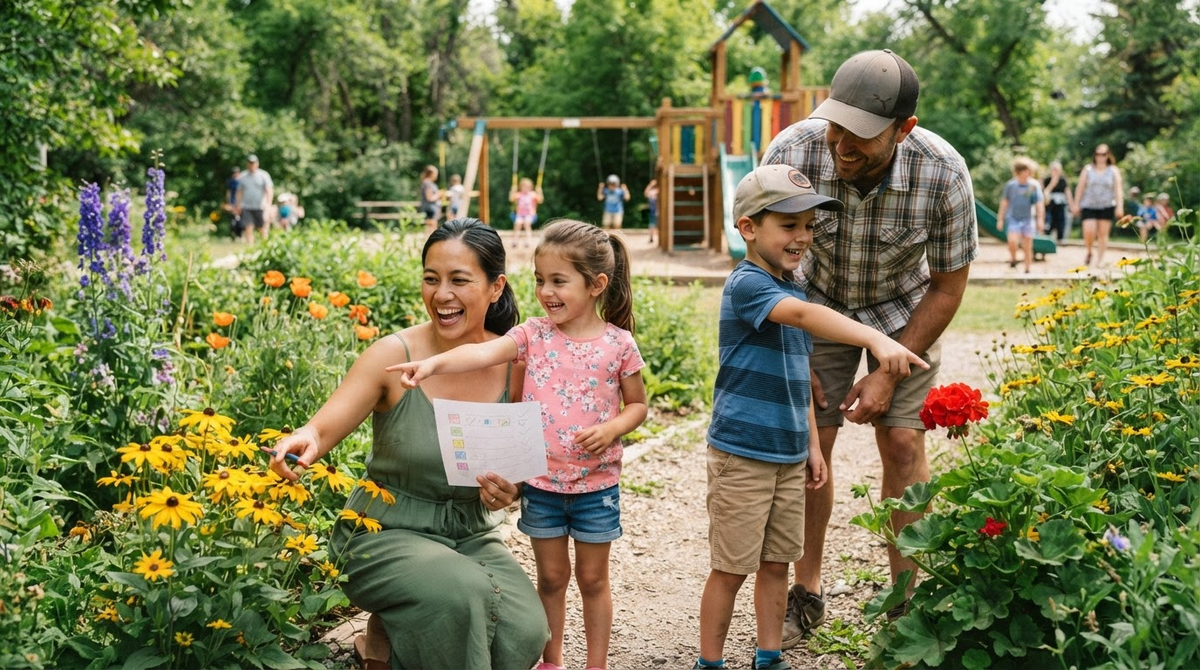
A summer colour hunt is an easy family activity that requires very little preparation.
It can be completed:
- In a backyard
- Around the block
- At a community park
- Along a walking trail
- Near Mirror Lake
- At a campground
- During a family road-trip stop
The goal is not to collect objects.
The goal is to slow down, look carefully and notice how many colours appear in an ordinary outdoor space.
A colour hunt also gives families a simple reason to walk, move and spend time together outside.
What You Need
Bring:
- A printed or handwritten colour list
- A pencil or washable marker
- A small notebook
- A phone or camera when photographs are appropriate
- Water
- Sunscreen
- Weather-appropriate clothing
- Insect repellent when needed
Children can draw their discoveries instead of photographing them.
Basic Colour Hunt
Ask everyone to find something representing each colour:
- Red
- Orange
- Yellow
- Light green
- Dark green
- Blue
- Purple
- Pink
- White
- Grey
- Brown
- Black
- More than one colour
Possible discoveries may include:
- Flowers
- Leaves
- Rocks
- Birds
- Insects
- Signs
- Playground equipment
- Clothing
- Buildings
- Vehicles
Encourage children to observe natural objects without picking plants, disturbing animals or entering unsafe areas.
Add Observation Challenges
After completing the basic list, try finding:
- The brightest object
- The smallest colourful object
- The largest colourful object
- Two objects that are almost the same colour
- A colour hidden in a shadow
- A colour reflected in water
- An object with three or more colours
- Something whose colour changes in sunlight
- A colour that was difficult to find
- A colour that surprised you
There are no winners or losers.
The activity is about noticing details and sharing discoveries.
Try a Photo Version
Older children can photograph one object for each colour.
When the hunt is finished:
- Review the photographs together.
- Put them in rainbow order.
- Create a digital collage.
- Choose the most unusual discovery.
- Talk about which colour was easiest or hardest to find.
Do not photograph strangers without permission.
Stay on public paths and respect private property.
Try a Drawing Version
Give each child a notebook page divided into coloured sections.
When they find something:
- Draw the object
- Write its name
- Record where it was found
- Describe its texture or shape
- Add another colour seen nearby
This version works well when families prefer to leave phones at home.
Make It Easier for Younger Children
For younger children, begin with four colours:
- Red
- Yellow
- Green
- Blue
Use simple prompts:
- Can you find something green?
- Can you point to something yellow?
- Which colour do you see the most?
- Can you find two things that match?
An adult can mark the checklist while the child searches.
Add Challenges for Older Children
Older children may enjoy finding:
- A natural example and a human-made example of each colour
- Five different shades of green
- An example of camouflage
- A colour created by light or reflection
- A plant with more than one colour
- A sign that uses colour to communicate
- An object that appears different from a distance
Ask them why certain colours may help plants, insects, birds, signs or buildings.
The purpose is observation and conversation, not a formal science lesson.
Create a Colour Story
After returning home, ask everyone to choose three discoveries and build a short story around them.
For example:
A yellow butterfly landed beside a purple flower while a red wagon rolled past.
Children can write the story, tell it aloud or illustrate it.
Respect Nature and Shared Spaces
Follow a few simple rules:
- Stay on marked or appropriate paths.
- Do not pick unfamiliar plants or mushrooms.
- Do not touch or chase wildlife.
- Leave nests and habitats undisturbed.
- Do not enter private property.
- Take all garbage home.
- Follow posted park rules.
- Wash hands after outdoor activities.
Adults should supervise children near roads, parking areas, water and uneven ground.
Adapt the Activity to the Weather
On a hot day:
- Choose a shaded route.
- Go earlier in the morning.
- Bring water.
- Keep the activity shorter.
After rain:
- Look for colours reflected in puddles.
- Watch for slippery paths.
- Wear suitable footwear.
On a windy day:
- Notice moving leaves, flags and clouds.
- Avoid areas with damaged or unstable trees.
Check the weather before leaving home.
Printable Summer Colour Hunt
Find These Colours
- Red
- Orange
- Yellow
- Light green
- Dark green
- Blue
- Purple
- Pink
- White
- Grey
- Brown
- Black
- More than one colour
Bonus Discoveries
- Brightest object
- Smallest object
- Largest object
- Three colours together
- Colour reflected in water
- Colour hidden in a shadow
- Natural and human-made matching colours
- Most surprising discovery
Date: ____________________
Location: ____________________
Weather: ____________________
Favourite discovery: ________________________________
Hardest colour to find: ______________________________
For Families with Different Abilities
Make the activity flexible.
Participants can:
- Walk, roll or sit in one location
- Point instead of writing
- Describe colours aloud
- Use photographs
- Work as one team
- Search from a window, patio or park bench
- Focus on textures, shapes or sounds when colour identification is difficult
The goal is shared participation, not completing every item.
Trusted Source
Public Health Agency of Canada — Physical Activity Tips for Children
The Public Health Agency of Canada encourages active family activities, walking, playground visits and regular movement for children.
A successful colour hunt does not require finding every colour.
The best discoveries may be the details your family usually walks past without noticing.
Simple takeaway: Slow down, look closely and see how colourful an ordinary summer walk can be.